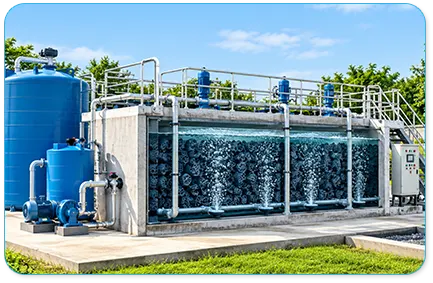
Fixed film activated sludge combines attached-growth and suspended-growth biological treatment within the same treatment system. We assess your wastewater characteristics, flow rates, organic loading, available footprint, discharge requirements, and operating conditions to determine the appropriate system configuration.
Our engineering team then develops the biological treatment system, considering fixed media, aeration, hydraulic conditions, solids separation, and sludge management for your project.
Design a fixed film activated sludge system for your project today!
Fixed Film Treatment Systems Delivered
Treatment Capacity Installed
Years of Engineering Experience
Wastewater Projects Served
Every biological treatment project presents different loading, space, and operational requirements. Instead of applying the same fixed-film configuration to every application, at Reacto we evaluate the wastewater characteristics and treatment objectives before determining the appropriate media, aeration, reactor configuration, and downstream solids separation.
| Your Requirement | Our Engineering Approach |
|---|---|
| Limited biological treatment footprint | Higher biomass retention within the available reactor volume |
| Higher organic loading | Fixed media for additional attached microbial growth |
| Existing plant capacity constraints | Fixed-film integration for suitable biological reactors |
| Need for combined biological treatment | Attached-growth and suspended-growth treatment in one system |
| Variable wastewater loading | Biomass retention through fixed media |
| Treatment plant upgrade | Retrofit-oriented fixed-film configuration |
| Controlled biological treatment | Application-specific media and aeration design |
| Consistent treated water quality | Integrated biological and solids separation design |
Every fixed film activated sludge system begins with understanding your wastewater and process conditions — not selecting media first.
We analyse wastewater source, flow variation, BOD, COD, TSS, organic loading, and treatment requirements to establish the biological treatment objectives.
Our engineers determine the appropriate fixed-film configuration based on wastewater characteristics, treatment capacity, available space, hydraulic conditions, and required treated water quality.
Reactor configuration, fixed media arrangement, aeration requirements, hydraulic flow, solids separation, piping, and controls are engineered into one coordinated system.
System components are manufactured, assembled, inspected, and tested according to the approved engineering design before dispatch.
The system is installed, commissioned, and operating parameters are optimised under actual site conditions to support stable biological treatment.
The performance of a fixed film activated sludge system depends on maintaining the right biological, hydraulic, and operating conditions.
| Parameter | Engineering Consideration |
|---|---|
| Wastewater Source | Domestic / Commercial / Suitable Industrial |
| Daily Flow | Average & Peak Flow Rate |
| BOD & COD | Organic Loading Assessment |
| TSS | Solids Loading & Separation |
| Organic Loading | Biological Treatment Capacity |
| Fixed Media | Surface Area & Media Configuration |
| Biomass | Attached & Suspended Growth |
| Aeration | Oxygen Transfer Requirement |
| Hydraulic Conditions | Flow Distribution & Reactor Mixing |
| Available Footprint | Reactor Size & Media Arrangement |
| Sludge Management | Solids Recirculation & Wasting |
| Water Reuse | Additional Treatment Requirement |
| Automation | Manual to Fully Automated |
| Compliance | Applicable CPCB and Local Regulatory Requirements |
We engineer fixed film activated sludge systems for different biological treatment requirements, project scales, and existing plant conditions.
Biological treatment systems designed with fixed media and suspended biomass for new wastewater treatment projects.
Fixed-film configurations for suitable existing biological treatment systems where additional treatment capacity is required.
Engineered configurations that use fixed media to support higher biological loading within the available treatment volume.
Fixed-film systems designed for projects where available biological treatment space is limited.
Combined attached-growth and suspended-growth treatment within the same biological treatment stage.
Fixed-film integration assessed around existing reactor geometry, hydraulics, aeration, and downstream treatment infrastructure.
A fixed film activated sludge system requires coordinated biological, mechanical, and hydraulic components.
| Component | Function |
|---|---|
| Fixed Media | Provides surface area for attached microbial growth |
| Biological Reactor | Supports attached and suspended biological treatment |
| Aeration System | Supplies oxygen and supports mixing |
| Media Retention System | Keeps fixed media within the biological treatment zone |
| Secondary Clarifier | Separates suspended biological solids from treated water |
| Sludge Recirculation | Returns biological solids to the treatment stage where required |
| Sludge Handling | Manages excess biological solids |
| Tertiary Treatment | Provides additional treatment where required for reuse or discharge |
Our fixed film activated sludge systems can be engineered for diverse wastewater treatment environments.
Choosing fixed film technology is only one part of the wastewater treatment design. We coordinate biological treatment, fixed media, aeration, hydraulics, solids separation, and project requirements to develop a complete treatment system.
Every system begins with wastewater analysis and treatment objectives rather than a predefined media or system configuration.
We engineer the interaction between attached microbial growth and suspended biological treatment as part of one coordinated process.
Fixed media selection and arrangement are considered according to biological loading, reactor conditions, hydraulic flow, and treatment requirements.
Existing treatment infrastructure can be assessed for fixed-film integration where the reactor, hydraulics, aeration, and treatment objectives are suitable.
Aeration, biological treatment, clarification, sludge management, piping, and controls are coordinated during the engineering stage.
One engineering team manages process design, system integration, manufacturing, testing, installation, commissioning, and technical support.
Different wastewater conditions require different biological treatment configurations. Share your wastewater characteristics, treatment capacity, available space, and existing infrastructure with our engineering team to develop a suitable fixed film activated sludge system.
Conventional activated sludge primarily uses microorganisms suspended in the mixed liquor for biological treatment. A fixed film activated sludge system additionally provides fixed media that supports attached microbial growth within the reactor.
Yes, suitable existing biological treatment systems can be assessed for fixed-film integration. The existing reactor configuration, hydraulic conditions, aeration system, loading, and treatment requirements need to be evaluated before selecting an upgrade approach.
Key factors include wastewater flow, BOD, COD, TSS, organic loading, available reactor volume, fixed media configuration, aeration requirements, hydraulic conditions, solids separation, and treated water requirements.
Yes. Additional tertiary treatment and disinfection can be incorporated when treated wastewater is intended for approved non-potable reuse. The required treatment depends on the target water quality and intended reuse application.