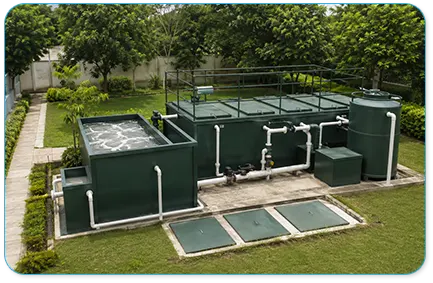
Reacto engineers decentralized sewage treatment plants that treat wastewater close to where it is generated, helping reduce extensive sewer networks, long-distance pumping, and overall infrastructure costs while enabling local water reuse wherever applicable.
As one of the trusted decentralized sewage treatment plant suppliers, we deliver customised systems for residential, commercial, institutional, and industrial developments.
Let's engineer a decentralised wastewater treatment solution for your site.
Decentralized STPs Delivered
Years of Engineering Experience
Distributed Treatment Capacity
Residential, Commercial & Institutional Projects
A decentralized STP processes sewage where it comes from, eliminating the need for conventional pipeline systems and pumping, and allowing the reuse of treated water close to the point of treatment.
| Conventional Centralised STP | Decentralized STP |
|---|---|
| Extensive sewer network required | Wastewater treated close to its source |
| Higher pumping requirements | Reduced pumping infrastructure |
| One central treatment location | Multiple distributed treatment units |
| Higher pipeline installation costs | Reduced sewer network investment |
| Network expansion for future growth | Independent treatment units can be added where required |
| Single-point operational dependency | Distributed treatment improves operational flexibility |
Our engineers determine the most effective treatment locations before selecting the appropriate process and system configuration.
Here's our step-by-step process:
We study the site layout, wastewater generation points, daily flow, topography, and utility corridors to identify where decentralized treatment units can be installed most effectively.
The site is divided into logical treatment zones based on wastewater generation patterns, pipeline routing, and future development plans. Each decentralized treatment unit is sized to serve its designated catchment area.
The appropriate biological treatment process—ASP, IFAS, SBR, BioMimicry, or EcoSept—is selected for each treatment zone based on wastewater characteristics, discharge standards, reuse objectives, and available space.
Each treatment system is manufactured under controlled conditions and undergoes equipment verification, dimensional inspection, leak testing, and control panel validation before dispatch.
Each decentralized treatment unit is installed close to its service area, commissioned individually, and integrated into the overall wastewater management network for reliable long-term operation.
As experienced decentralized sewage treatment plant manufacturers, we customise the specifications below to match your project requirements.
| Parameter | Specification |
|---|---|
| Plant Configuration | Decentralized, Distributed Treatment System |
| Treatment Capacity | 10 KLD - 20 MLD (Customisable) |
| Installation Type | Above Ground / Below Ground / Skid-Mounted |
| Construction Material | MS/FRP/SS/RCC (Project-Specific) |
| Service Coverage | Individual Buildings/Zones/Campus-Level Networks |
| Influent Type | Domestic/Commercial/Institutional Wastewater |
| Treated Water Quality | Designed to meet applicable CPCB/Local Regulatory Standards |
| Water Reuse | Landscaping, Flushing & Other Approved Non-Potable Applications |
| Automation | Manual/Semi-Automatic/Fully Automatic |
| Operation & Maintenance | Low-Maintenance Design with Easy Equipment Access |
We design independent sewage treatment facilities for projects where managing sewage at the point of origin improves operational efficiency, reduces infrastructure requirements, and supports long-term system flexibility.
Distributed treatment across multiple residential clusters.
Independent treatment for multiple office buildings and shared utilities.
Local treatment for guest blocks, villas, and amenities.
Dedicated treatment for hospital campuses and healthcare facilities.
Serves schools, colleges, universities, and hostels.
Treatment across production units, warehouses, and utility zones.
Ideal for smart cities, public utilities, and government developments.
Suitable for mining camps, construction sites, and off-grid facilities.
A distributed wastewater treatment system performs best when treatment locations, hydraulic networks, and treatment technologies are engineered together.
As experienced decentralized sewage treatment plant manufacturers, we deliver dependable decentralized wastewater solutions through:
Each treatment unit is positioned according to wastewater generation patterns, site layout, and hydraulic flow to optimise collection and treatment.
Treat wastewater closer to the source, helping minimise underground pipeline infrastructure and long-distance wastewater conveyance.
Shorter collection networks reduce the need for pumping stations, improving operational efficiency and lowering energy consumption.
ASP, IFAS, SBR, BioMimicry, or EcoSept technologies are selected based on wastewater characteristics, discharge standards, and reuse objectives.
Multiple treatment units are engineered to operate independently while supporting a coordinated wastewater management strategy across the site.
Treated water is available close to the point of treatment for approved non-potable applications such as landscaping, flushing, and utility use.
Collaborate with our team of engineers to determine the best approach for distributed treatment of sewage for your property's layout, sewage circulation, and long-term maintenance needs. As decentralized sewage treatment plant suppliers, Reacto delivers customised solutions engineered for reliable long-term performance.
The choice depends on factors such as site layout, wastewater generation points, available land, and infrastructure requirements. Our engineers assess these parameters before recommending the most suitable approach.
Yes. Decentralized systems can be integrated into existing residential, commercial, institutional, and industrial developments, subject to site conditions and available space.
Not necessarily. Depending on the level of automation and project configuration, multiple treatment units can be monitored and managed through a coordinated operational approach.
Typical inputs include site layout, estimated wastewater generation, occupancy or population data, available land, discharge or reuse requirements, and future development plans.