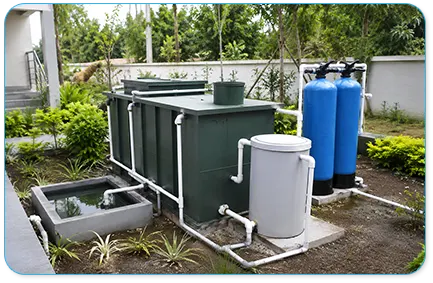
Bigger isn't always better when it comes to sewage treatment. A residential community, school, clinic, hotel, or small industrial unit rarely needs the same capacity as a large facility, which is why our small scale sewage treatment plant solutions are designed around actual wastewater generation rather than unnecessary capacity. We engineer small-scale systems around your actual treatment requirements, so you get reliable treatment, regulatory compliance, and water reuse without paying for capacity you'll never use.
Let's design the right treatment solution for your wastewater volume.
Small-Capacity Systems Delivered
Typical Capacity Range
Years of Engineering Experience
Industries Served
Smaller sewage flows require a different treatment approach than large urban or industrial facilities. The focus is on selecting a practical system that is easy to install, operate, and maintain while delivering consistent treatment performance.
| Project Requirement | Small Scale STP Solution |
|---|---|
| Low daily sewage generation | ✓ Designed for lower flow rates |
| Limited capital investment | ✓ Right-sized treatment capacity |
| Restricted installation area | ✓ Compact layouts available |
| Water reuse requirements | ✓ Supports approved non-potable reuse |
| Low maintenance preference | ✓ Simplified operation |
| Residential & institutional projects | ✓ Well suited |
We develop only for the treatment capacity needed to service the real need, not inadequately planned or oversized.
We evaluate daily sewage generation, occupancy patterns, peak flow variation, and future usage to determine the optimum treatment capacity without oversizing the plant.
Treatment technologies such as ASP, IFAS, SBR, BioMimicry, or EcoSept are selected based on wastewater characteristics, loading variation, maintenance expectations, and treated water reuse requirements.
Process units, equipment, and hydraulic retention are engineered specifically for smaller capacities and hydraulic load, ensuring stable biological treatment, efficient aeration, and reliable performance.
All systems are pre-assembled and checked in the factory prior to shipment to minimise manual labour and guarantee reliable performance from the very beginning.
The plant is commissioned by calibrating process parameters to suit actual site conditions, ensuring consistent treatment performance even under variable occupancy and low-flow conditions.
Designing smaller treatment plants involves different engineering priorities than large-capacity systems. The parameters below determine how the small-capacity treatment solution is configured.
| Parameter | Engineering Consideration |
|---|---|
| Daily Sewage Generation | Right-sized treatment capacity |
| Occupancy Pattern | Intermittent and low-flow operation |
| Peak Hydraulic Load | Biological process stability |
| Available Installation Space | Compact system configuration |
| Water Reuse Requirement | Tertiary treatment selection |
| Operator Availability | Simplified operation & maintenance |
| Power Availability | Energy-efficient equipment selection |
| Discharge Standards | CPCB/Local regulatory compliance |
Small-scale treatment systems are suitable where wastewater generation is relatively low but consistent treatment performance and regulatory compliance remain essential.
Independent sewage treatment for low-rise residential developments.
Designed around student occupancy and seasonal usage patterns.
Supports guest accommodation with treated water available for landscaping and flushing.
Reliable treatment for smaller healthcare facilities and medical campuses.
Suitable for offices, retail spaces, and mixed-use developments.
Designed for facilities with comparatively low domestic sewage generation.
Reacto engineers every solution around actual wastewater generation, ensuring stable performance, practical operation, and efficient use of available resources.
Treatment capacity is calculated from actual wastewater generation, occupancy patterns, and peak flow conditions, helping avoid oversized systems that increase CAPEX and operating costs.
ASP, IFAS, SBR, BioMimicry, or EcoSept is selected based on loading variation, wastewater characteristics, and operational requirements to maintain consistent biological performance at smaller capacities.
System layouts are developed to minimise installation requirements while integrating treatment equipment, piping, and utilities into a practical footprint.
Equipment and automation levels are configured to suit facilities with limited operational staff, simplifying routine monitoring and maintenance.
Where reuse is planned, tertiary treatment processes are incorporated to support approved non-potable applications such as landscaping and flushing.
Where future expansion is anticipated, systems are engineered with provisions that simplify capacity upgrades without redesigning the complete treatment process.
Avoid paying for treatment capacity you don't need. Discuss your wastewater generation, site conditions, and water reuse requirements with our engineers to identify the most suitable small scale sewage treatment plant solution.
There is no fixed definition. Capacity depends on wastewater generation, occupancy, and project type rather than a standard KLD range.
Yes. Depending on treatment objectives and applicable regulations, treated water can be reused for approved non-potable applications such as flushing and landscaping.
The appropriate technology depends on wastewater characteristics, flow variation, available space, and discharge requirements rather than plant size alone.
Where future growth is anticipated, systems can be engineered with provisions that simplify capacity upgrades.
Daily wastewater generation, occupancy patterns, site layout, available space, discharge standards, and water reuse objectives help determine the most suitable treatment solution.