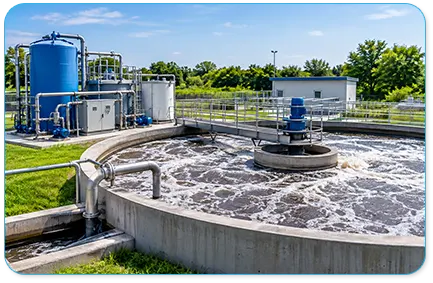
The activated sludge wastewater treatment process uses biological processes to remove organic pollutants from wastewater before it is discharged or reused. At Reacto, we design activated sludge systems based on your wastewater parameters, treatment capacity, site conditions, and the treated water quality you need to achieve.
We select the process configuration to keep the biological treatment stable while managing energy consumption, operating requirements, and long-term performance of the plant.
Share your project details with our team to get an activated sludge wastewater treatment system suited to your requirements.
Years of Engineering Experience
Wastewater Treatment Projects
Treatment Capacity Delivered
Industries Served
Activated sludge treatment uses microorganisms to biologically break down biodegradable organic matter in wastewater. Our process combines aeration, biological treatment, solids separation, and sludge management to produce treated water suitable for the required discharge or reuse application.
| Treatment Stage | Purpose |
|---|---|
| Preliminary Treatment | Removes larger solids and materials that could interfere with downstream treatment |
| Primary Treatment | Reduces settleable solids and part of the organic load where required |
| Aeration | Supplies oxygen to microorganisms for biological degradation of organic matter |
| Secondary Clarification | Separates biological solids from the treated water |
| Sludge Recirculation | Returns a controlled portion of settled biomass to maintain the required biological concentration |
| Sludge Wasting | Removes excess biological solids from the treatment system |
| Tertiary Treatment | Provides additional treatment where higher treated water quality or reuse is required |
Every activated sludge wastewater treatment system requires process conditions that support stable biological activity and reliable solids separation. Our engineers evaluate the wastewater and project conditions before developing the treatment configuration.
We assess wastewater source, flow rates, BOD, COD, TSS, nutrient levels, variability, and other relevant parameters to establish the biological treatment requirements.
Treatment capacity, organic loading, hydraulic loading, aeration requirements, sludge concentration, and process configuration are determined according to the project requirements.
Aeration equipment and oxygen transfer requirements are designed to maintain suitable conditions for biological treatment while considering energy consumption and operating requirements.
Secondary clarification and sludge recirculation are configured to support effective separation of biological solids and maintain stable treatment performance.
The system is manufactured, inspected, and installed as per the approved engineering design. Our team then commissions the plant and sets the operating parameters based on actual site conditions, ensuring consistent performance from the start.
The specifications below can be customised according to wastewater characteristics, treatment capacity, installation conditions, and treated water requirements.
| Parameter | Specification |
|---|---|
| Treatment Process | Activated Sludge Process |
| Treatment Capacity | 10 KLD - 20 MLD(Customisable) |
| Biological Treatment | Aerobic Biological Treatment |
| Aeration System | Diffused Aeration / Project-Specific Configuration |
| Clarification | Secondary Clarifier |
| Sludge Recirculation | Return Activated Sludge (RAS) |
| Sludge Management | Waste Activated Sludge (WAS) Management |
| Construction Material | MS / FRP / SS / RCC (Project-Specific) |
| Installation | Above Ground / Below Ground |
| Automation | Manual / Semi-Automatic / Fully Automatic |
| Influent Type | Domestic / Commercial / Industrial Wastewater |
| Treated Water Quality | Designed to meet applicable CPCB and local regulatory requirements |
| Water Reuse | Designed for approved non-potable applications where required |
| Maintenance | Equipment and process units designed for practical access |
Activated sludge systems are suitable for projects requiring biological treatment of wastewater with biodegradable organic loads and consistent treatment performance.
Activated sludge treatment performs reliably when aeration, biological loading, solids concentration, clarification, and sludge management are considered together. Reacto engineers these elements around your project's wastewater profile and operating requirements.
Treatment parameters are developed according to wastewater characteristics, hydraulic loading, organic loading, and required treated water quality rather than a fixed system configuration.
Aeration capacity and equipment selection are engineered around oxygen requirements, biological loading, operating conditions, and energy considerations.
Process conditions are configured to support consistent microbial activity and biological degradation across expected wastewater loading conditions.
Secondary clarification and sludge recirculation are designed together to maintain appropriate biomass concentration and support reliable treated water quality.
The treatment process is configured to meet applicable discharge standards based on your project's treated water requirements.
Where treated water reuse is required, additional treatment stages can be incorporated to support approved non-potable applications such as landscaping and flushing.
Our engineering team supports the project through process design, equipment selection, manufacturing, installation, commissioning, and technical support.
Share your wastewater flow, treatment objectives, site conditions, and discharge or reuse requirements with us. Our engineering team will review the details and design an activated sludge wastewater treatment system suited to your project.
Activated sludge sewage treatment uses microorganisms to remove biodegradable organic matter from sewage and wastewater through a biological treatment process. It is commonly used where steady biological treatment is needed before the water is discharged or treated further for reuse.
Activated sludge works well for wastewater with biodegradable organic load — but the process should be chosen only after checking the flow, BOD, COD, TSS, variation in wastewater quality, and the treated water requirements. Reacto reviews these parameters first and then decides the right treatment configuration for the project.
Activated sludge systems can be designed for different capacities, depending on the wastewater generation and loading conditions of the project. We decide the plant capacity from the actual and peak flow — not from a standard plant size.
Yes. Additional tertiary treatment and disinfection can be integrated when treated water is intended for applications such as flushing or landscaping. The treatment stages are selected according to the required reuse water quality.